Commercial Restaurant Cooking & Stainless Steel Kitchen Equipment In Malaysia: Why Standard Solutions Often Fail
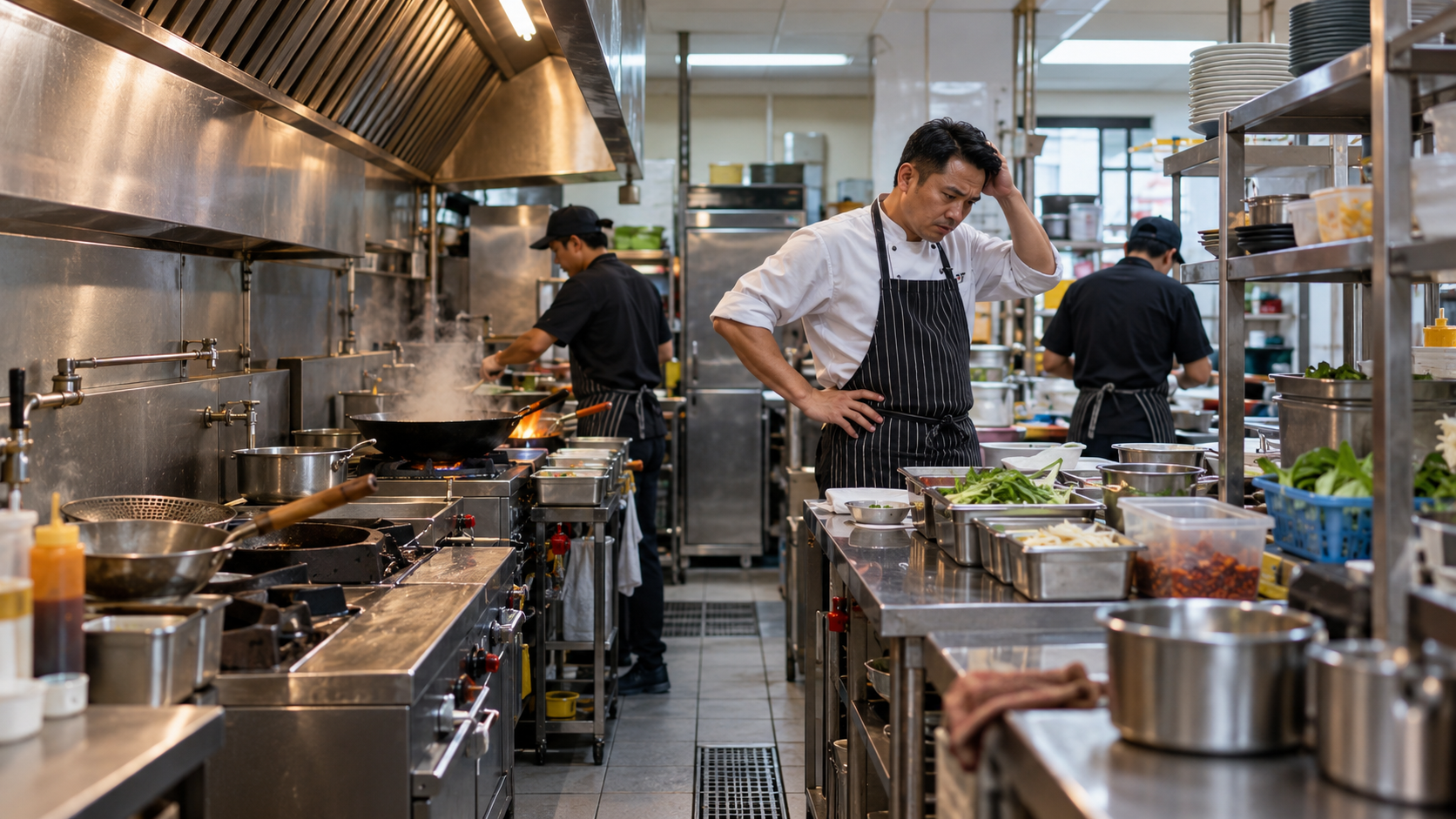
A commercial kitchen is not simply a room filled with appliances. It is a production environment where equipment capacity, workflow, ventilation, utilities, hygiene, maintenance access and staff movement all affect daily output.
For Malaysian F&B operators, this matters even more because kitchen formats vary widely. A café, mamak outlet, Chinese restaurant, hotel kitchen and central production facility may occupy similar floor areas but require very different equipment layouts.
Choosing commercial cooking equipment based only on price, brand, or physical dimensions can create operational problems after opening. Equipment needs to support the menu, peak production volume and available infrastructure. The same applies when choosing commercial restaurant equipment or planning stainless steel kitchen equipment in Malaysia for a new or existing outlet.
The right approach starts with kitchen operations, not the equipment catalogue.
Commercial Restaurant Equipment Should Be Selected Around Production Flow
Commercial kitchen planning should begin by mapping how ingredients move through the operation.
A typical workflow may include:
Receiving
Storage
Preparation
Cooking
Plating
Service
Washing
Problems occur when those stages overlap unnecessarily.
For example, if staff carrying raw ingredients regularly cross the plating area, the layout is inefficient. If the refrigerator is several metres from the preparation bench, staff lose time with every order. If a fryer or burner blocks access to another workstation, congestion increases during peak service.
Commercial restaurant equipment should be positioned to reduce unnecessary movement while keeping related workstations close together.
Before equipment is ordered, operators should assess:
- Number of kitchen staff per shift
- Peak-hour order volume
- Preparation sequence
- Cooking processes
- Refrigerated and dry storage requirements
- Dishwashing flow
- Waste movement
- Cleaning access
- Maintenance access
Equipment selection becomes much more accurate once these operational requirements are clear.
Commercial Cooking Equipment Must Match the Menu and Peak Capacity
Equipment capacity should be based on production demand rather than average sales.
If a restaurant serves 300 customers per day but half of those orders occur between noon and 2 p.m., equipment must be capable of handling that peak period.
This is especially important when selecting commercial cooking equipment such as wok ranges, burners, fryers, steamers, griddles and stock-pot stoves.
A unit that performs adequately during normal periods may become a bottleneck during peak service.
Malaysian restaurants also have cooking requirements that can differ significantly between concepts. A wok-based kitchen may require high-output burners and substantial extraction capacity. A mamak operation may require simultaneous cooking, beverage preparation and food holding. A café may place greater emphasis on refrigeration and compact preparation stations.
Capacity planning should consider output per hour, recovery time, staff requirements and the expected menu mix.
Buying equipment that is too small can restrict output. Buying oversized equipment wastes space, increases capital cost and may consume more energy than necessary.
Stainless Steel Kitchen Equipment In Malaysia Should Fit The Site
Standard equipment dimensions are convenient, but commercial premises are rarely standard.
Shoplots may contain columns, uneven walls, existing drainage points, fixed gas lines, electrical distribution boards or limited access between kitchen areas. These constraints can leave unusable gaps when only standard-sized equipment is installed.
This is where custom stainless steel kitchen equipment in Malaysia can provide practical advantages.
Items commonly fabricated to suit specific spaces include:
- Preparation tables
- Sink units
- Wall shelves
- Floor racks
- Cabinets
- Equipment stands
- Trolleys
- Food preparation counters
- Service counters
- Exhaust hoods
Custom fabrication lets dimensions follow available space and operating requirements.
However, custom fabrication should solve a defined problem. It is not automatically better than ready-made equipment.
Standard units remain suitable where dimensions, capacity and specifications already meet operational needs. Many efficient commercial kitchens use a combination of standard appliances and customised stainless-steel workstations.
Commercial Restaurant Equipment Must Allow Cleaning And Maintenance Access
One of the most common planning mistakes is fitting equipment too tightly together.
A kitchen may look efficient on a floor plan because every centimetre appears to be used. In practice, insufficient access can make cleaning, servicing and component replacement difficult.
When positioning commercial restaurant equipment, operators should consider more than front-facing working space.
Technicians may need access to:
- Electrical connections
- Gas connections
- Refrigeration compressors
- Drain lines
- Control panels
- Filters
- Motors
- Ventilation components
If equipment has to be dismantled or several units moved every time routine servicing is required, maintenance becomes slower and more expensive.
Cleaning access is equally important.
Gaps where grease, food debris and moisture accumulate can become hygiene problems. Stainless-steel work surfaces should therefore be planned alongside adjoining equipment, wall finishes, floor drainage, and cleaning procedures.
Commercial Cooking Equipment Must Be Planned With Utilities
Equipment specifications cannot be considered separately from the building.
Before installing commercial cooking equipment, the site should be assessed for gas, electricity, water, drainage and ventilation requirements.
Electrical appliances must match the available electrical supply and circuit capacity. Gas appliances require appropriate installation and connection arrangements. Water-using equipment must have suitable supply and drainage points.
Heat-producing appliances also affect ventilation requirements.
A high-output cooking line may require a properly designed exhaust hood and ducting system to remove heat, grease-laden vapour and cooking fumes.
Adding more cooking capacity without reviewing ventilation can create uncomfortable working conditions and add load to the kitchen environment.
Regulatory requirements may also apply to certain gas and electrical equipment in Malaysia. Equipment approvals, installation requirements and competent-person requirements should be confirmed where applicable before commissioning.
Commercial kitchen planning should therefore coordinate equipment selection with the mechanical and electrical requirements of the site.
When Custom Stainless Steel Kitchen Equipment In Malaysia Makes More Sense
Customisation is most valuable when it improves space utilisation or solves an operational problem.
Consider a narrow restaurant kitchen where a standard 1,500 mm preparation table leaves a 250 mm gap against the wall. That space may be too small to use but large enough to collect dirt.
A custom table could be fabricated to fill the area while adding storage below.
The same principle applies to stainless steel kitchen equipment in Malaysia used in food trucks, small shop lots, mamak restaurants and existing kitchens undergoing renovation.
Customisation may be suitable when:
1.
Standard equipment leaves significant unused space.
2.
Several functions need to be combined into one workstation.
3.
Unusual dimensions prevent standard units from fitting.
4.
Existing utilities limit equipment positioning.
5.
A specialised cooking or preparation process requires a specific layout.
6.
Additional storage needs to be integrated into the workstation.
The decision should be based on operational benefit rather than appearance alone.
Commercial Restaurant Equipment Should Be Evaluated by Total Cost
Initial purchase price is only one part of equipment cost.
A lower-priced machine may become expensive if it causes frequent downtime, requires difficult repairs or has inadequate capacity.
The total cost of commercial restaurant equipment can include:
- Purchase price
- Installation
- Utility consumption
- Maintenance
- Spare parts
- Repair labour
- Downtime
- Replacement cost
- Lost production
Layout decisions also affect cost.
Poorly positioned equipment may require additional plumbing, electrical work or gas piping. Replacing incorrectly sized equipment after opening can involve both equipment cost and renovation work.
Operators should therefore evaluate equipment based on expected service life, operating requirements, maintainability, and production capacity.
Plan Commercial Cooking Equipment Before Construction Is Finalised
The best time to make major kitchen equipment decisions is before renovation and utility positions are fixed.
Equipment specifications affect electrical loads, gas requirements, drainage, water points, ventilation and floor layout.
Selecting commercial cooking equipment late in the project may require contractors to move services already installed.
A proper equipment schedule should ideally include:
- Equipment dimensions
- Electrical requirements
- Gas requirements
- Water requirements
- Drainage requirements
- Ventilation requirements
- Service clearances
- Installation requirements
This gives designers, contractors and equipment suppliers a common reference point.
For operators planning a new outlet, kitchen equipment should therefore be part of the design process rather than one of the final purchasing decisions.
Choose VChoose For Commercial Kitchen Planning And Equipment in Malaysia
At VChoose, we do not treat commercial kitchens as a collection of individual products.
We look at how your kitchen needs to operate, how much space you have, what your team will cook and how the equipment will fit into the complete workflow.
Our team supports restaurants, cafés, mamak outlets, caterers, food trucks and central kitchens with commercial restaurant cooking equipment, and custom stainless steel kitchen equipment in Malaysia.
When you work with VChoose, you can access:
- Free consultation and quotation
- Site visits and kitchen layout planning
- Custom stainless-steel fabrication
- Commercial cooking and refrigeration equipment
- Exhaust hood and ducting solutions
- Equipment installation support
- Competitive pricing
- Nationwide dealer coverage
- One-year equipment warranty
- After-sales repair and maintenance support
Our team brings decades of combined commercial kitchen industry experience to each project. We can help you determine where standard equipment is sufficient, where customisation adds value and how your equipment should fit into the wider kitchen plan.
If you are opening a new F&B outlet, renovating an existing kitchen or replacing equipment that no longer meets production requirements, speak with us at VChoose before making the next purchase.
We will help you build a commercial kitchen around your actual operation, not force your operation around the equipment.